






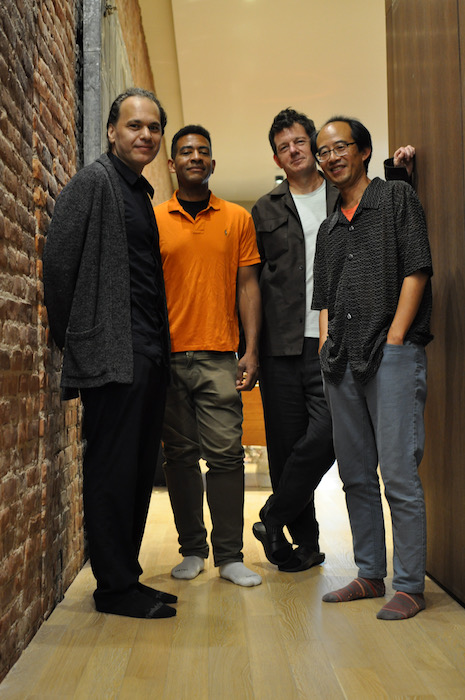


The FLUX Quartet, "one of the most fearless and important new-music ensembles around" (San Francisco Chronicle), has performed to rave reviews in venues worldwide, including the Tate Modern with BBC Radio3, Park Avenue Armory, Kennedy Center, Mount Tremper Arts, EMPAC, Walker Art Center, Carnegie's Zankel Hall, as well as international festivals in Australia, Europe and Asia. It has also premiered new works on numerous experimental incubators, including Roulette, The Music Gallery, and Mount Tremper Arts. FLUX’s radio appearances include NPR’s All Things Considered, WNYC’s New Sounds and Soundcheck, and WFMU’s Stochastic Hit Parade. The group’s discography includes recordings on the Cantaloupe, Innova, New World, Passin Thru, and Tzadik labels, in addition to two acclaimed releases on Mode encompassing the full catalogue of Morton Feldman’s output for string quartet.
Strongly influenced by the "anything-goes" philosophy of the fluxus art movement, violinist Tom Chiu founded FLUX in the late 90's. The quartet has since cultivated an uncompromising repertoire that combines late twentieth-century iconoclasts such as Cage, Nancarrow, Scelsi, and Ligeti with today's visionaries, including Oliver Lake, Michael Hersch, David First, Alvin Lucier, Michael Schumacher, Sean Shepard, Wadada Leo Smith, Julia Wolfe, Matthew Welch, and others. Having premiered over 100 new works, FLUX has been awarded grants from the American Composers Forum, Aaron Copland Fund, Meet-The-Composer, New Music USA, and Chamber Music America. FLUX also discovers emerging composers from its many college residencies, including Wesleyan, Dartmouth, Williams, Princeton, Bard, and the College of William and Mary.
The spirit to expand stylistic boundaries is a trademark of the FLUX Quartet, and to that end the quartet avidly pursues interdisciplinary projects, resulting in acclaimed new works with choreographers Pam Tanowitz and Christopher Wheeldon, avant balloonist Judy Dunaway, digital collective The OpenEnded Group, and visual artist Matthew Barney. In the upcoming season, FLUX will perform and record the full string quartet output of Toshi Ichiyanagi, widely acknowledged as an influential pioneer of the Japanese avant-garde.





Violist Max Mandel enjoys a varied and acclaimed career as a chamber musician, soloist, orchestral musician, and speaker. He is a member of the trailblazing ensemble FLUX Quartet, as well as Principal Viola of the Orchestra of The Age of Enlightenment. He has appeared as guest Principal Viola with The Chamber Orchestra of Europe, The Australian Chamber Orchestra, The Scottish Chamber Orchestra, The Academy of Ancient Music, and The canandian Opera Company Orchestra amongst others. Other group affiliation include The Smithsonia Chamber Players, Tafelmusik Baroque Orchestra, and The Silk Road Ensemble. His most recent record with FLUX is "Images From a Closed Ward" on New Focus Records. Also recently released is Mozart's Sinfonia Concertante with fellow violin soloist Aisslinn Nosky and the Handle & Haydn Society Orchestra on Coro Records. Born and raised in Toronto, Canada, he divides his time between New York and London.

Felix Fan's versatility has made him one of the most sought after cellists of his generation. As a chamber musician, he has performed with Yo-Yo Ma, Gil Shaham, and Janos Starker, in venues such as Carnegie Hall, The Kennedy Center, Musikverein and Royal Festival Hall. Fan's interest in contemporary music has led to collaborations with today's leading composers including George Crumb, Tan Dun, Oliver Knussen, Kaija Saariaho, and Charles Wuorinen. Appearances with the Bang on a Can All-Stars has allowed Fan to work with artists as diverse as Philip Glass, Meredith Monk, Terry Riley, and Lee Ranaldo of Sonic Youth. In 1998, Fan founded Muzik3, a performance series and commissioning foundation dedicated to the advancement of modern music with an emphasis on integrating theater, dance, and video. Muzik3 led to the formation of cello/percussion/piano trio Real Quiet, which has premiered over 20 works and recorded music by Marc Mellits (Endeavour Records) and David Lang (Naxos). In 2005, Fan performed a series of radio plays written by acclaimed screenwriters Charlie Kaufman and the Coen Brothers, starring actors Steve Buscemi, Philip Seymour Hoffman and Meryl Streep. Fan has also worked with innovative choreographers Karole Armitage, Shen Wei, and Christopher Wheeldon.